Why We’re Suddenly Talking About Computer Vision Again
Over the last few months, I’ve found myself hearing the term Computer Vision far more often than at any point in the past 10–20 years.
Not just from data scientists or technology vendors—but from CPG sales leaders, retail partners, and executives responsible for owning shopper experience.
That caught my attention.
So much so that I checked Google Trends. The result surprised me: searches for “Computer Vision” over the past few months are running at roughly 4× the level of the prior 20 years of trend data.
That raises an important question:
Why now? And why does it matter for CPG manufacturers working with retailers?
A Very Brief History of “Computer Vision”
The term Computer Vision didn’t originate in retail—or even in commercial technology.
It emerged in academic computer science in the 1960s and 1970s, rooted in a deceptively simple question: Can a computer be taught to see and understand the world the way humans do?
From the start, Computer Vision was about more than recognizing objects. It was about:
- Interpreting scenes
- Understanding spatial relationships
- Inferring conditions and context
That distinction matters. Image recognition tells you what is present. Computer Vision aims to understand what is happening.
Retail shelf analytics, at its core, is a Computer Vision problem—not because we want to identify products, but because we want to understand shelf conditions.
Why Computer Vision Is Resurfacing Now
The renewed attention isn’t nostalgia. It’s a signal that the definition of execution is changing.
For decades, retail execution was measured indirectly:
- Lagging sales data
- Coverage metrics
- Periodic audits
- Manual store walks
Execution was inferred, not observed.
Computer Vision changes that equation.
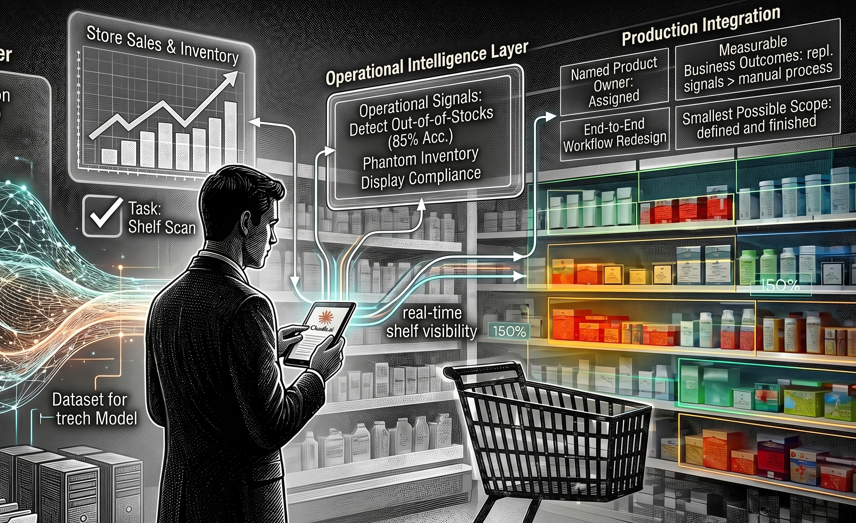
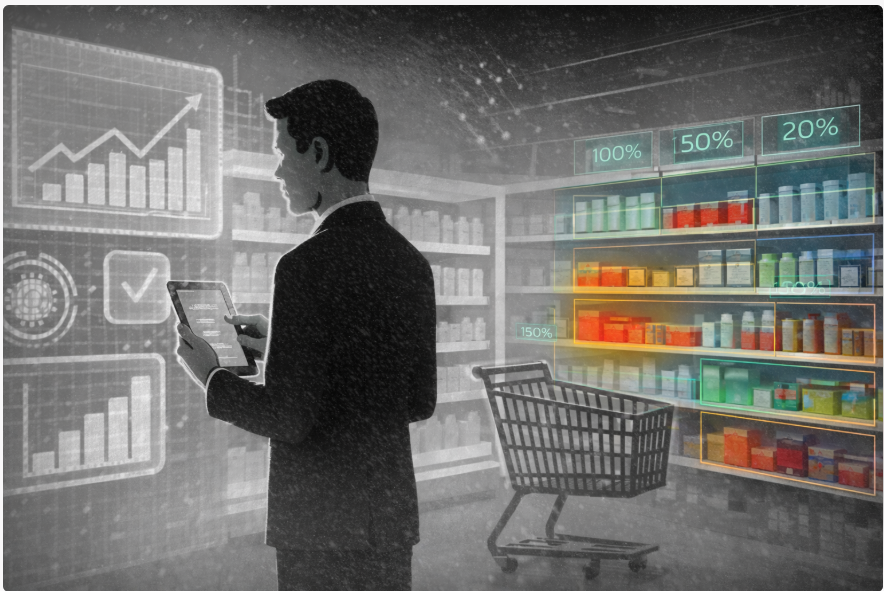
For the first time, manufacturers can see the shelf at scale—frequently, consistently, and with enough fidelity to describe conditions, not just outcomes.
At the same time, the economics have shifted dramatically. The cost of capturing images, processing them, and extracting meaning has collapsed. What was once experimental is now viable at enterprise scale.
That combination—new expectations of execution and lower cost of seeing—is why this conversation is happening now.
The Real “So What” for CPG Manufacturers
The real implication isn’t better images or more accurate detection.
It’s this:
Execution is no longer about compliance. It’s about situational awareness and responsiveness.
When manufacturers can observe shelf conditions directly, several things change:
- Execution moves from periodic inspection to continuous sensing
- Conversations with retailers shift from debate to shared reality
- Decisions can be made based on what is happening now, not what happened weeks ago
Computer Vision becomes a sensing layer—the voice of the shelf—feeding decisions across field execution, account teams, and upstream functions.
This forces a reset in how CPGs think about:
- What “great execution” actually means
- Who owns fixing issues when they are visible
- How quickly the organization is expected to respond
A Final Thought
If it feels like Computer Vision suddenly showed up everywhere, it’s because the shelf is no longer a black box.
We’re talking about it now because we can finally see at the speed the business demands—and because once you can see, not acting becomes a choice.
For CPG manufacturers, the question is no longer whether Computer Vision works.
It’s whether the organization is ready for a world where shelf conditions are visible—and shopper experience can be optimized.