The CPG KAM's Software Landscape: What Exists, What Doesn't, and Why
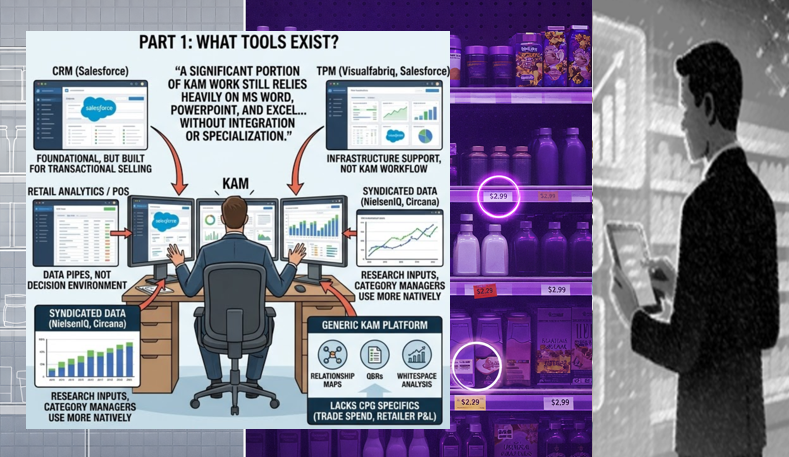
Part 1: What Tools Does the CPG Key Account Manager (KAM) Actually Have?
Here's the landscape:
Tools the KAM might use, but weren't built for them:
- CRM (Salesforce, etc.) Often the foundational layer, but account managers pull together ad-hoc combinations of CRM, spreadsheets, Word documents, checklists, and emails to manage accounts, rather than having a "single pane of glass." CRM was built for transactional selling, not strategic account stewardship.
- TPM Software (Visualfabriq, Salesforce etc.) Technically adjacent to the KAM's world, but primarily owned by Trade Finance and Customer Marketing. The goal is for the key account manager to dedicate more time to driving the business. TPM is infrastructure support, not a KAM workflow tool.
- Retail Analytics / POS data platforms (Exceedra, Salesforce, etc.) Data feeds the KAM uses, but these are data pipes, not decision-making environments built around how a KAM thinks and works.
- Syndicated data (NielsenIQ, Circana; increasingly augmented by data provided directly from retailers) Research inputs, not KAM tools. Category Managers arguably use these more natively.
- Generic/packaged KAM platforms (rather than list, would like to hear directly from some of the Saas/package providers) These exist and have real value, but they're often built for generic B2B key account management (think industrial, SaaS, services), not the CPG-specific context. They handle relationship maps, account plans, QBRs, and whitespace analysis, but they have no awareness of trade spend, retailer P&L, POS data, joint business planning rhythms, or the buyer-seller power dynamics unique to CPG.
What this means in practice: A significant portion of KAM work still relies heavily on MS Word, PowerPoint, and Excel, with data scattered across CRM, MDM, ERP, and BI platforms; without integration or specialization for KAM needs. And the Bain perspective is damning: while retailers and other functions within consumer products companies have benefited from big investments in digital solutions — such as advance pricing and promotional analysis tools in trade marketing — the key account manager job continues to be performed very much over a simple spreadsheet, often missing even basic sell-out data.
Part 2: Why Don't More Purpose-Built SaaS Tools Exist for the CPG KAM?
This is the more interesting question. There are several compounding structural reasons:
1. The KAM's "product" is a relationship, not a process. Every other Sales role we can name (Field Sales, Trade Promo, Category Management), has a repeatable, codifiable workflow at its core. Retail execution follows a store visit cadence. TPM follows a promotion lifecycle. Planograms follow shelf physics. The KAM's core output is trust, strategic alignment, and negotiated value with a specific retailer. KAM software that relies on "rules engines" and machine learning works in direct contrast to KAM practice, where large customers want personalized service and a machine can't do an account manager's job. Software that automates the relational and contextual is extremely hard to build.
2. The KAM sits at the intersection of every function; and owns none of them. The KAM synthesizes trade spend data, category data, supply chain data, shopper insights, financial P&Ls, and retailer strategy, but none of those data systems belong to them. The KAM team is the face of cross-functional capability to the retailer, yet they are actually the last mile of many upstream processes. Building a SaaS tool that serves this synthesis role means integrating with every other system in the enterprise.
3. Retailer asymmetry makes standardization nearly impossible. Retailers are pursuing many new initiatives at the micro-market and store level and expecting CPG companies to support these initiatives, and each major retailer (Walmart, Kroger, Amazon, Costco) has an entirely different data environment, portal, negotiation cadence, and strategic priority set. A Walmart KAM and a Kroger KAM might as well be doing different jobs. Retailers like Amazon, Carrefour, and Walmart are using algorithms to manage more of the business, and sales teams must learn to understand and influence brand and category recommendations made by algorithms; meaning the KAM's workflows are increasingly retailer-dictated, not standardizable.
4. The JBP (Joint Business Planning) process is the KAM's signature artifact, and it's a nightmare to “productize”. The most important thing a KAM produces is the annual Joint Business Plan and possibly even the Quarterly Business Reviews (QBR’s). The outcome is often a long, self-centric document meant more for internal consumption than real customer conversation, with only a few minutes to present to a retailer who will likely only remember two or three ideas. The JBP needs to combine forward-looking volume forecasts, trade investment scenarios, category growth narratives, and retailer P&L modeling. Each retailer's specific strategic frame, data sets and ways of working. No software category has cracked this. It lives in PowerPoint.
5. The power imbalance makes the KAM a "receiver" of retailer data, not a generator. US retailers use their data to dictate terms to CPG brands, demanding higher fees for prime shelf space or exclusive promotions, while CPG companies often struggle to gain direct access to consumer data. The KAM's analytical leverage depends on retailer-provided data (Walmart Luminate/Scintilla, Kroger 84.51°, etc.) data that lives in retailer portals, not CPG systems. Any KAM tool that wants to be truly useful has to integrate with data that the retailer controls and monetizes separately. That's a structural barrier that no SaaS vendor fully controls.
6. The KAM population is small and concentrated at large CPGs; a thin target market for most SaaS vendors. Field sales has thousands of reps per company. Category managers exist at every tier. But true strategic KAMs are a small, senior population; maybe a few dozen at even the largest CPG manufacturers. The total addressable market for a purpose-built CPG KAM SaaS is narrow, the sales cycle to enterprise CPGs is long, and the ROI story is hard to prove quantitatively (because the KAM's impact is embedded in negotiation outcomes that are difficult to attribute).
The So What…
The CPG KAM is one of the highest-leverage roles in the entire commercial organization. For most CPG commercial teams, achieving business objectives during any given year is more dependent on the quality of their relationships with key customers than any other longer-term growth lever. Yet the role sits in a SaaS desert because its core work is relational, cross-functional, retailer-dependent, and strategically bespoke in ways that resist productization. The tools that do exist are either horizontal KAM platforms that don't understand CPG, or CPG-specific tools (TPM, retail analytics) that don't understand the KAM's workflow.
The gap is real, well-documented, and persistent. And it's exactly why the role is still largely run on PowerPoint, Excel, and relationships. How are you seeing this change with the rise of agentic and AI driven workflows?
#CPG #ConsumerPackageGoods #RetailStrategy #Accenture