UPDATED-Why Most AI Demos Don't Become Products: Product, Feature, Capability, or Use Case? Pick One Before You Build
Ray Boyd
CPG & Retail AI Leader | TCIO (Total Commercial Investment Optimization) | Trade, RGM & Retail Media | Salesforce + Snowflake Agentic Ops | Driving Growth & Margin
May 13, 2026
Last week I wrote about how most AI proof-of-concepts fail because teams lead with the interface instead of the signal, and because prototypes get funded as experiments instead of products.
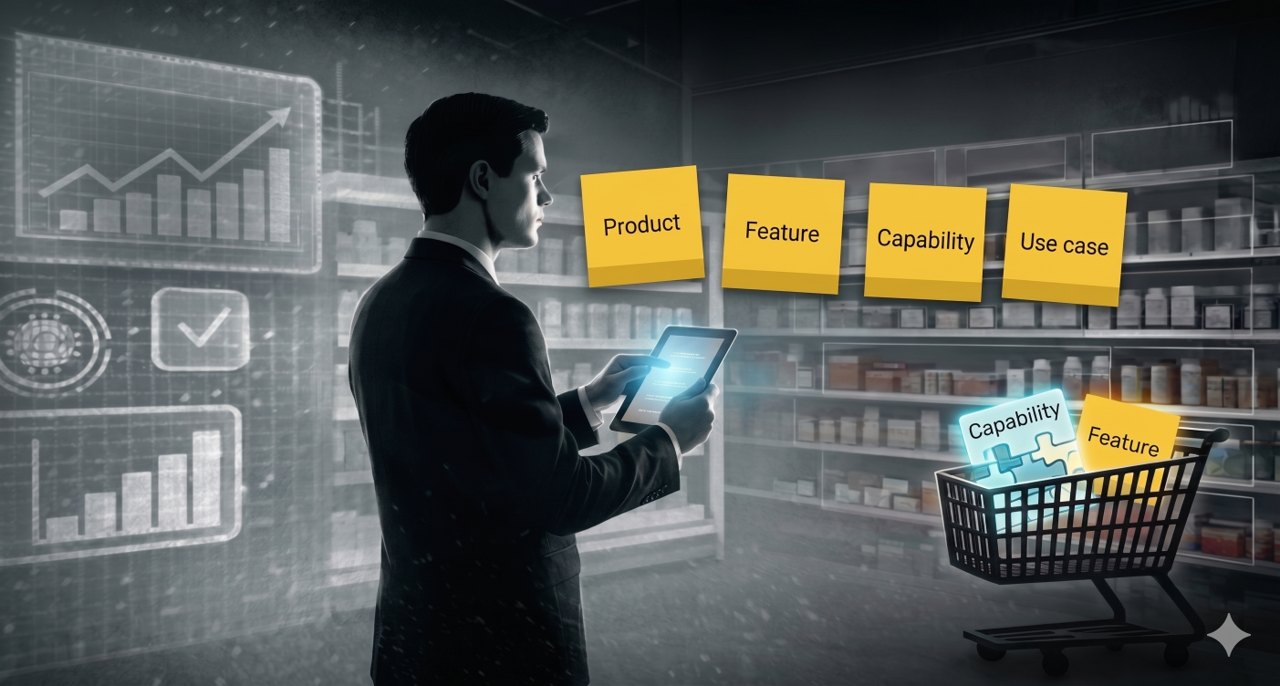
Here's the follow-on theory I'm now testing: most POCs fail because nobody named what was actually being built. A product? A feature? A capability? A use case? These are not synonyms. And teams use them interchangeably.
The four things a POC could actually be
· Product. A net-new application that teams license, IT integrates, leadership funds, and procurement evaluates. The thing on the org chart.
· Feature. A new function inside a product that already exists. A retailer briefing view inside the CRM. A compliance check inside the retail execution app.
· Capability. A reusable building block that lives across multiple products. Content generation. Enterprise search. Not a thing customers buy. A thing products are built from.
· Use case. A single workflow demonstrating that a capability solves a real problem. Not licensed, not deployed, not owned. Proof that the signal is real.
Different funding profiles. Different owners. Different timelines. Different definitions of done. Very different conversations with IT.
Why this matters
When you call something a POC without naming the category underneath, the default scope is almost always "new product." Because that's what the demo looks like. So the team scopes the integration as if they're building a product. Sizes the roadmap as if they're building a product. Then the conversation turns to system of record, ownership, support model, and run-rate cost, and the project quietly dies.
Gartner has predicted that over 40% of agentic AI projects will be cancelled by 2027. A real share of those aren't failing because the technology stopped working. They're failing because the category was never named.
The conversation before anything gets built
Before a line of code, I make the team answer one question out loud: what type of thing are we building?
If it's a feature, the platform exists, the users exist, the data exists. Ship small, measure, move on.
If it's a capability, identify the products that will consume it. A capability without a host is infrastructure in search of a use case.
If it's a use case, prove the signal. Smallest defensible scope. Done well, it's a business case with legs. Done poorly, it's a slide.
If it's a product, everyone in the room needs to agree, out loud, that they're signing up to build the organizational infrastructure (ownership, funding, support, adoption) that doesn't appear automatically. That's a different category of work than running a POC.
One last trap worth naming: "we use Claude" is not a product. Neither is "we use Copilot." Those are model-layer dependencies. The product is the workflow, the proprietary data, the orchestration, and the closed loop around the model.
The mindset shift
The teams I've watched move fastest stopped using "POC" as a way to avoid naming what they were building, and started using the taxonomy as a forcing function. Product, feature, capability, or use case: pick one before the work starts. The answer changes who owns it, who funds it, how long it takes, what "done" looks like, and whether IT is being asked to integrate or to invent.
A demo without that clarity isn't a head start. It's a head fake.
When your team kicks off the next AI initiative, who in the room can answer, in one sentence, whether you're building a product, a feature, a capability, or a use case? And what happens when the answers don't match?
#AgenticAI #CPG #ProductManagement #Accenture