Why Claude Demos Rarely Become Products
Ray Boyd
CPG & Retail AI Leader | TCIO (Total Commercial Investment Optimization) | Trade, RGM & Retail Media | Salesforce + Snowflake Agentic Ops | Driving Growth & Margin
May 6, 2026
Having worked in CPG industry and consulting, I have a long list of use cases where I know there just has to be a better way of doing things. Real-time shelf visibility is one such challenge. Can you guess what was the first thing I built with Claude.ai Enterprise at Accenture? Hint, it was not a demo.
It wasn't a dashboard. It wasn't an agent or an app. It wasn't even something visible.
I asked Claude to generate two years of synthetic Walmart store-level POS data. Roughly 1.2 million records. Forty items. Hundreds of stores. Messy, realistic, seasonally-shaped data that looked like what you'd actually pull from Walmart's Scintilla/Luminate vendor portal.
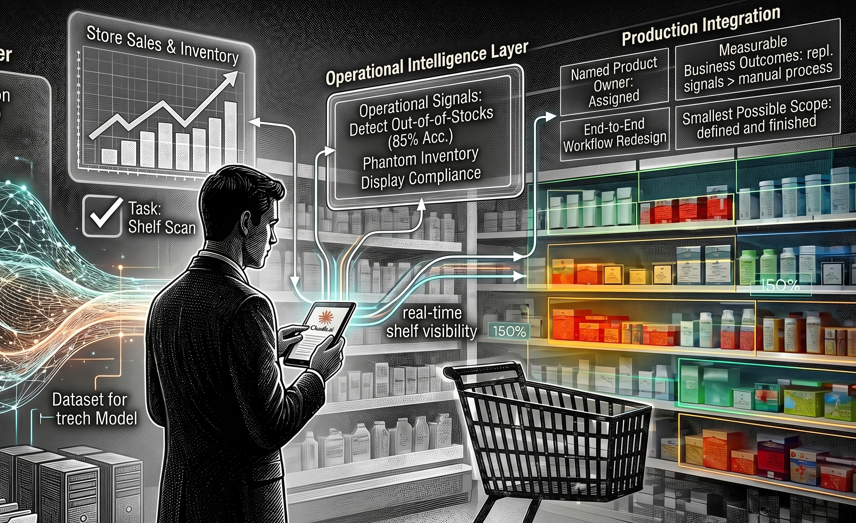
Then I had Claude build models and algorithms to run against the newly created synthetic data so we could reliably detect out-of-stocks, phantom inventory and display compliance issues... It worked with over 85% accuracy.
That sequence: problem first, data second, model third and interface last, turned out to matter more than I expected. Much of what I'm watching fail right now is being worked in the opposite order.
The frustration is real
I've been hearing the same thing from across the industry for months: the demos are impressive, but there's no there-there. Or… “IT organizations can't harden them, can't roll them out, can't defend them to a governance committee”.
Some of that frustration is fair. Some of it is aimed at the wrong target... Those amazing demos!
Where it actually breaks in CPG
I've watched enough of these projects stall to have a theory about where the friction concentrates.
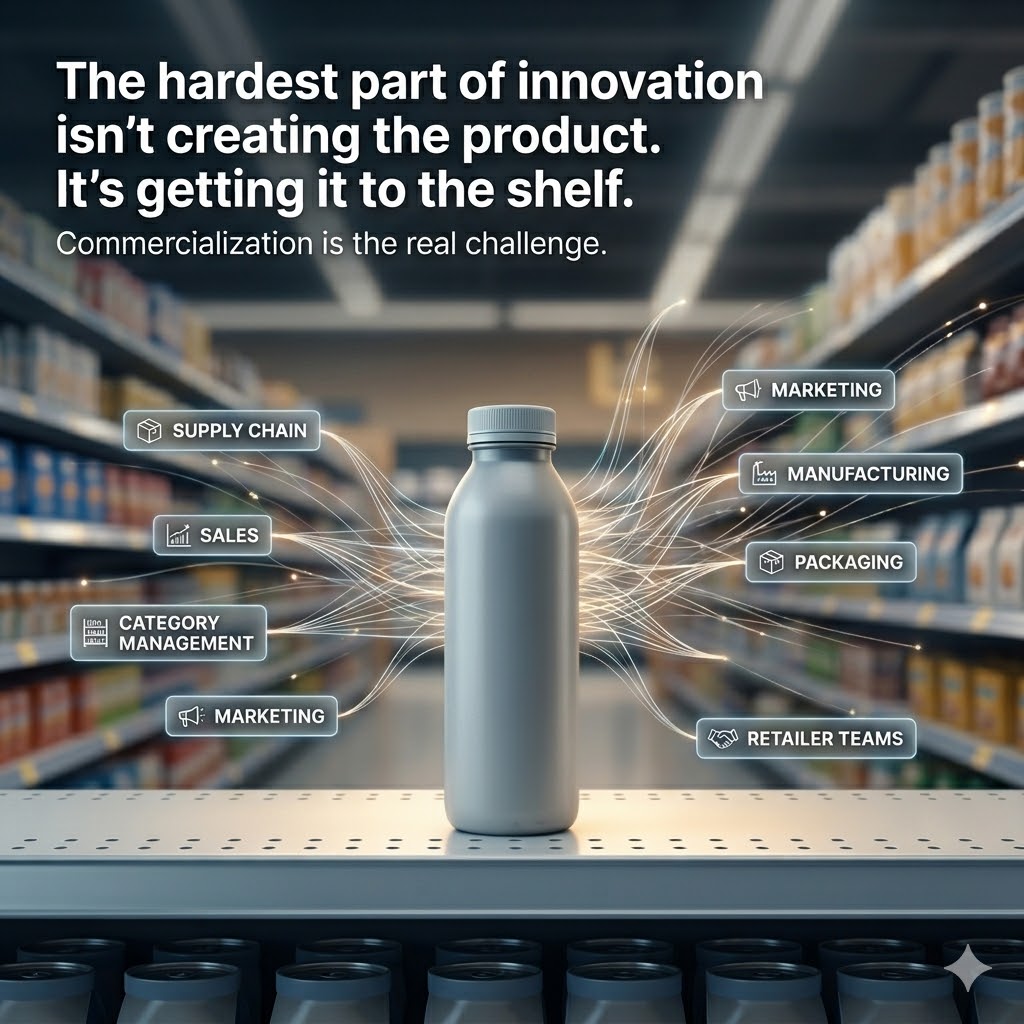
It's not that the AI doesn't work. It's that IT organizations were built to fund, govern, and deploy applications; most often using an agile sprint-based methodology. The applications we're building now are closer to agents: Goal-oriented (narrow in scope). Adaptive (often solving point in time solutions). Capable of reasoning across data that was never designed to talk for itself.
So the demo works. Or at least my demos always work. And then comes the question: "How does this connect to our actual data?" And suddenly a 5-day timeline to market is eaten by a 14-month IT roadmap. That's not a failure of AI capability. That's an operating model designed for a different era of software.
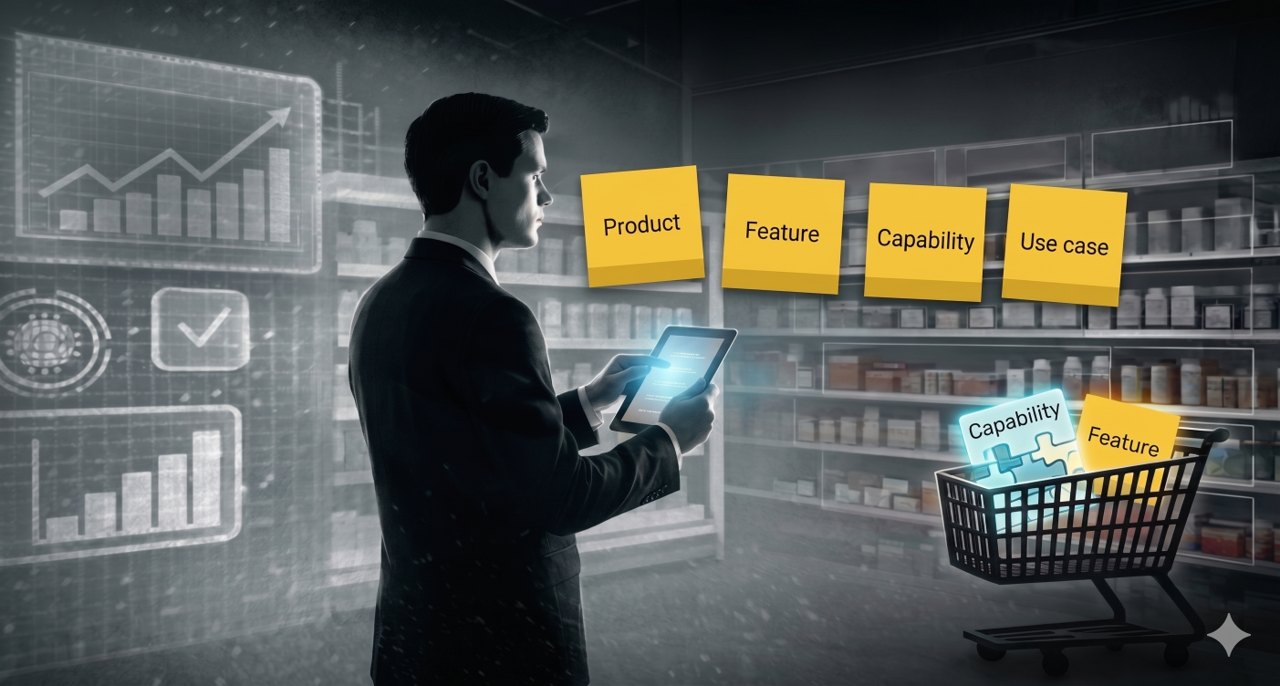
But there's a second, quieter reason the demo never becomes a product: it was never treated like one. Most AI demos are funded as experiments, staffed as projects, and evaluated as proofs of concept. There is no product owner. No iterative delivery model. No definition of done that connects to a business outcome. When the engagement ends or the attention shifts, there is nothing to hand off, because nobody was ever building a product. They were building a demo. And demos, however impressive, have no natural next step.
What to stop doing and start doing instead
I've stopped leading with the interface. When I'm building something now, I start with the specific operational problem and whatever data is actually available. Even when it is not clean, not perfect. The data can be synthetic at 11PM at night when you are building the application to validate the model, but by 9AM the next morning the data should be real. Even if the data has to be uploaded from Excel, PDF or even PPT. I want to know whether the signal is actionable before I ask an IT organization to do anything about it.
The goal is to prove something quantifiable in the smallest possible scope. A replenishment signal that beats the current manual process. A JBP insight that takes four minutes instead of 4 days to prepare.
Then, and only then, I wrap it in something an enterprise can actually absorb: clear workflows, defined ownership, measurable outcomes, and an honest conversation about what integration really requires.
Critically, I've started pushing clients to name a product owner before a single line of code gets written. Not a project sponsor. Not an IT lead who picks it up alongside three other priorities. A named owner with a mandate, a backlog, and accountability for what the thing does in production six months from now. Modern product delivery works in CPG when the sequencing is right: small scope, fast iteration, outcome-first measurement, and a person whose job it is to make sure the thing keeps getting better. That discipline is what separates a demo that lives on a laptop from a capability that actually changes how a commercial team works.
Keep the application small enough to finish and specific enough to defend. Not a platform. Not a roadmap. A working thing that solves one real problem well enough that someone wants to do it again.
The demos aren't the problem. They're the inspiration.
The real work is everything that comes after. In my experience, the organizations that move from demo to production share one habit: they treat the demo as a hypothesis, not a deliverable. Organizations reporting meaningful financial returns are twice as likely to have redesigned end-to-end workflows before selecting modeling techniques, not the other way around. The instinct to build first and justify later is exactly what creates the stall.
Best practice tips: Identify the smallest real problem that can be solved end-to-end. Then appoint a product owner before scaling. Measure business outcomes from day one, not technical benchmarks. And be willing to have the hard conversation about integration requirements (sips and slivers rather than industrial scale APIs).
Where have you been able to close the gap or do current ways of working keep getting in the way?