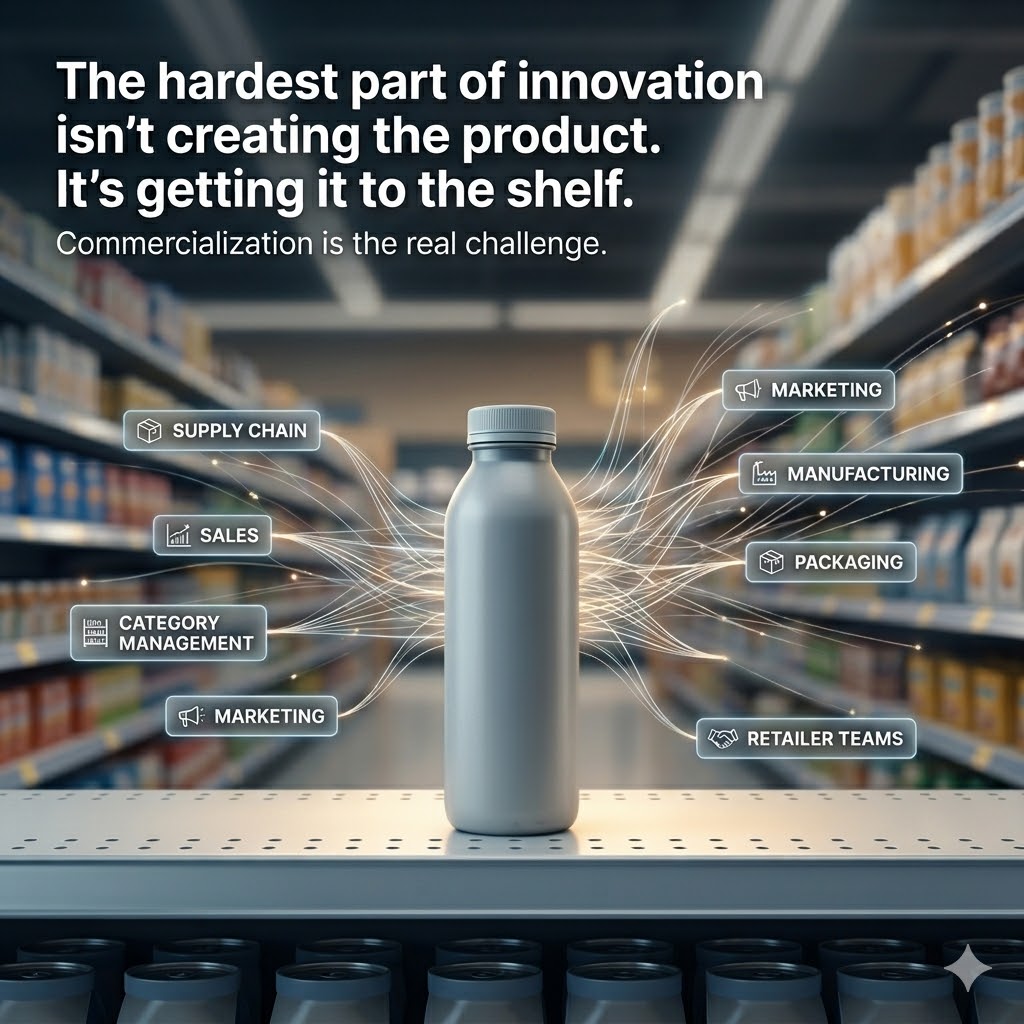
The Hardest Part of Innovation Isn't Creating the Product
It's getting it to the shelf.
Why Agentic AI May Finally Solve CPG Commercialization
Consumer goods companies have spent decades investing in technology to support innovation.
There are mature platforms for idea management, product lifecycle management (PLM), formulation, packaging, demand planning, trade promotion management, and retail execution. Yet one critical part of the innovation lifecycle remains surprisingly underserved: commercialization.
By commercialization, I mean everything that happens after a product is approved but before it successfully reaches the shelf. This includes retailer sell-in, assortment authorization, supply chain readiness, launch coordination, distribution execution, and ensuring products arrive where and when they are supposed to.
For a process that often determines whether a new product succeeds or fails, commercialization is still frequently managed through spreadsheets, emails, status meetings, and manual trackers.
Why?
Because commercialization has always been difficult to standardize.
Unlike demand planning or trade promotion management, commercialization is not owned by a single function. It spans R&D, marketing, sales, category management, supply chain, manufacturing, and retailer teams. Every group contributes to launch success, but no single department owns the entire process.
Complicating matters further, every retailer operates differently. A launch at Walmart follows a different timeline, approval process, and execution model than a launch at Kroger, Target, CVS, or Amazon. The result is a highly situational process that does not fit neatly into rigid software workflows.
Traditional enterprise applications thrive on repeatable, high-volume processes with consistent rules. Commercialization is the opposite. Every launch introduces new products, customers, dependencies, and risks.
As a result, the market never produced a category-defining commercialization platform. Instead, companies stitched together capabilities across PLM systems, project management tools, retailer portals, and countless spreadsheets.
The cost of this gap is significant.
Many launches underperform because of commercialization failures rather than product failures. Delayed retailer authorization, incomplete distribution, supply disruptions, missed shelf resets, and execution gaps can all negatively impact early sales velocity.
And in today's retail environment, velocity matters more than ever.
Retailers closely monitor performance during the first weeks and months of a launch. Products that fail to meet expectations can quickly lose shelf space, face reduced distribution, or be discontinued altogether. A delayed or poorly executed launch can create a negative trajectory that is difficult to reverse.
This is where agentic AI may finally change the equation.
Unlike traditional software, agentic solutions are not constrained by predefined workflows. They can operate across systems, understand context, monitor dependencies, identify risks, and adapt to the unique circumstances of each launch.
Imagine an intelligent commercialization agent that continuously monitors retailer readiness, supply chain milestones, packaging approvals, forecast changes, and execution signals. Instead of relying on teams to manually coordinate dozens of moving parts, the agent proactively identifies risks, recommends actions, escalates issues, and helps keep launches on track.
In essence, agentic AI brings situational awareness to a process that has historically depended on human coordination.
The irony is that commercialization may have been too complex and variable for traditional software to solve. Those same characteristics make it an ideal candidate for agentic systems.
#CPG #ConsumerGoods #Commercialization #ProductLaunch #RetailExecution #SalesTransformation #AgenticAI #DigitalTransformation